


Connected asset management software can reduce the complexity of managing information assets, business risks and compliance requirements in separate systems. When departments rely on disconnected spreadsheets, teams may struggle to identify critical resources, understand operational dependencies and maintain accurate records.
Connected asset management software brings these activities into a more structured environment. By linking information assets with business processes, risk assessments and compliance documentation, organisations can improve visibility and make more informed decisions.
Platforms such as Blue Octopus support this approach by connecting relevant management information in one place.
How Connected Asset Management Software Works
Why Connected Asset Management Software Matters
Every organisation relies on information assets to perform essential activities. These may include business applications, databases, cloud services, documents and supporting infrastructure.
However, maintaining an asset inventory is only the first step. Teams also need to understand how those resources support business operations, which risks affect them and who is responsible for managing them.
For example, a critical application may support several departments and depend on an external cloud provider. If the provider experiences an outage, multiple business processes could be affected. Connecting this information helps organisations understand dependencies and establish clearer responsibilities.
Building a Reliable Information Asset Register
A structured asset register provides the foundation for effective asset management. For each important resource, organisations should record relevant information such as its purpose, responsible owner, criticality and dependencies.
Teams should also review records when systems change or new services become available. For example, documenting which applications depend on a shared database allows management to identify potential operational impacts if that database becomes unavailable. As a result, asset information becomes a practical resource for risk assessments and business continuity planning rather than simply a technical inventory.
Connecting Business Processes with Information Assets
Business processes often depend on several applications, information resources and external services. Understanding these connections allows organisations to identify which resources support important activities and how disruptions could affect daily operations.
For instance, an order-processing system may depend on a customer database and a cloud hosting service. If one component fails, the entire process may be affected.
By linking assets with business processes, teams can document responsibilities, evaluate dependencies and identify critical services. Furthermore, this information supports Business Impact Analysis (BIA) and helps management establish suitable recovery priorities.
Improving Risk Management Through Connected Information
Risk assessments become more meaningful when organisations understand which information assets and business processes could be affected. For example, a cloud application may face risks involving unauthorised access, supplier outages or accidental data loss.
Teams can evaluate the likelihood and potential impact of these events, review existing controls and determine appropriate mitigation measures. They should also assign responsible owners and assess the remaining risk after implementing additional controls.
Connecting risk assessments with asset and process records helps management identify priorities and coordinate actions across departments. Instead of treating risks as isolated entries, organisations gain a clearer understanding of their potential business consequences.
How Connected Asset Management Software Supports Compliance Documentation
Accurate asset records, documented responsibilities and structured risk assessments also support compliance management. Frameworks such as ISO/IEC 27001 promote a risk-based approach to information security management. In Slovenia, Article 21 of the Information Security Act (ZInfV-1) requires covered essential and important entities to maintain relevant security documentation, including updated asset inventories and risk assessments. Article 22 addresses appropriate technical, operational and organisational security measures.
However, these requirements do not apply automatically to every business. Organisations must determine their specific legal obligations. Connected asset management software can help teams organise requirements, associate controls with supporting evidence and prepare documentation for reviews.
Nevertheless, maintaining records alone does not guarantee compliance. Organisations must also implement appropriate measures and demonstrate their effectiveness.
Practical Example: Connecting Assets, Risks and Processes
Consider a company that relies on a cloud application for customer orders. The application supports several business processes and depends on an external database service.
First, the company records the application and its dependencies in an information asset register. Next, it identifies the relevant business processes and evaluates the potential impact of a service outage. The team then assesses the risk, reviews existing safeguards and determines whether additional measures are necessary.
Finally, management assigns responsibility for mitigation actions and documents the outcome. This connected approach provides a clearer understanding of the relationships between information assets, operational risks and business activities.
How Blue Octopus Supports Connected Management
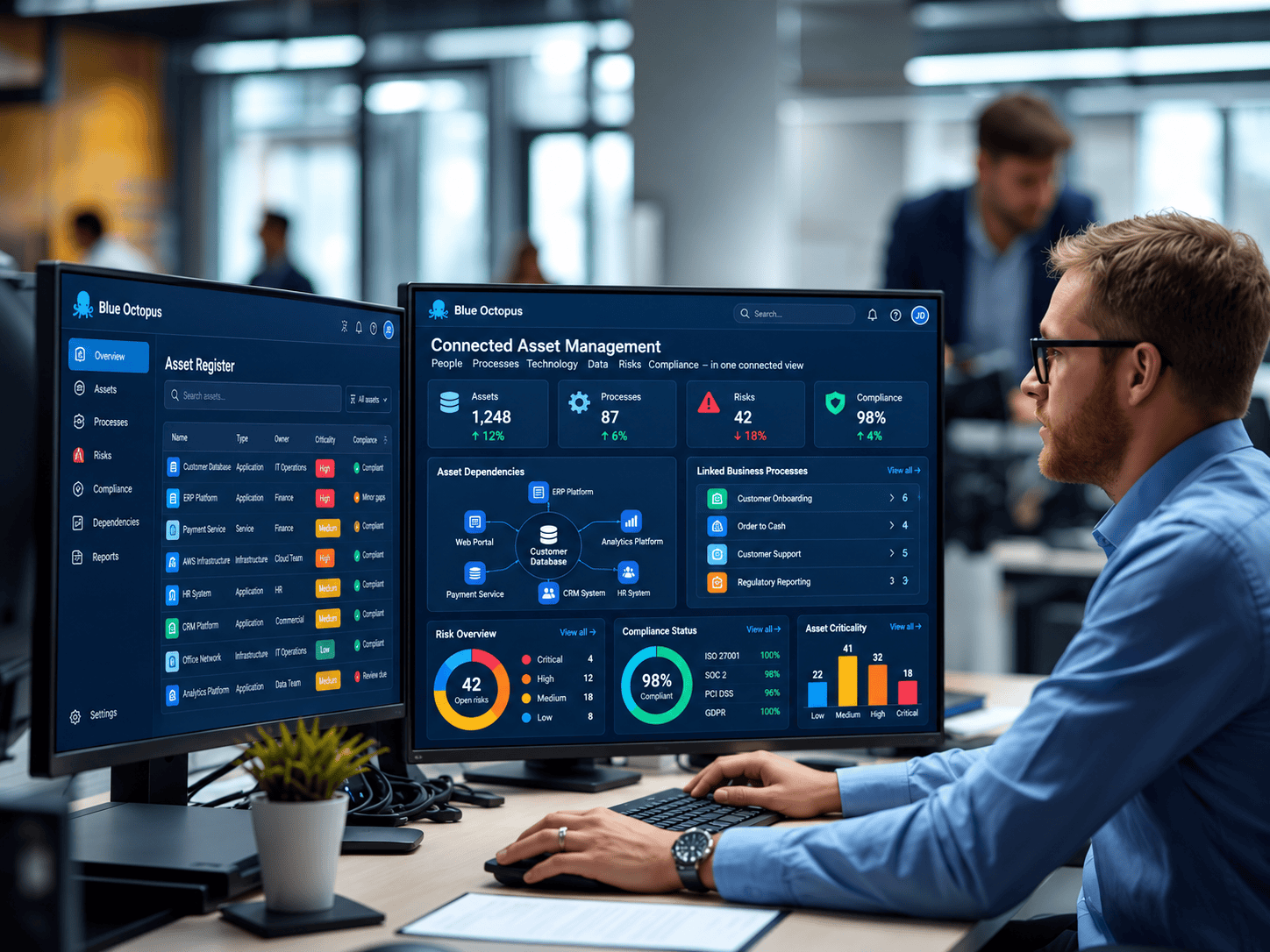
Blue Octopus provides a structured platform for managing information assets, business processes, risks and compliance documentation. Its functionalities include configurable information asset registers, asset ownership, criticality classification and visual dependency mapping.
The platform also supports business process records, structured risk assessments and mitigation planning. Furthermore, the compliance register helps organisations manage regulatory requirements, connect controls with supporting evidence and maintain relevant documentation. By connecting these activities, Blue Octopus helps teams coordinate responsibilities and obtain a clearer overview of business and information security risks.
However, it does not replace specialised hardware monitoring, equipment maintenance systems or technical cybersecurity controls. Explore the Blue Octopus modules to learn more.
Frequently Asked Questions
It is software that helps organisations manage asset information alongside related business processes, risks, responsibilities and compliance documentation.
It helps teams identify which assets and processes could be affected by potential threats, assess business impacts and prioritise mitigation measures.
Yes. It can help organise requirements, controls, responsibilities and supporting evidence. However, software alone does not establish regulatory compliance.
No. Blue Octopus focuses on structured information asset management, business processes, risk analysis and compliance documentation rather than automatic equipment monitoring.
Connecting Information for Better Business Decisions
Managing assets, risks, processes and compliance separately can make it difficult to understand how they affect one another. A connected approach provides a clearer view of important resources, responsibilities and operational dependencies.
By bringing relevant information together, organisations can support better risk management, improve compliance preparation and make more informed business decisions. Discover Blue Octopus to explore how connected information asset management can support your organisation.