


SWOT Analysis
From Situational Assessment to Strategic Decisions
SWOT analysis is an established strategic planning method that helps an organisation assess its strengths, weaknesses, opportunities and threats. In particular, strengths and weaknesses primarily concern internal characteristics. By contrast, opportunities and threats arise mainly from the external environment.
Although its four-part structure is simple, a valuable SWOT analysis goes beyond completing a matrix. They need to test their findings and decide which factors matter most. Next, they should examine how those factors interact and turn the insights into strategic choices.
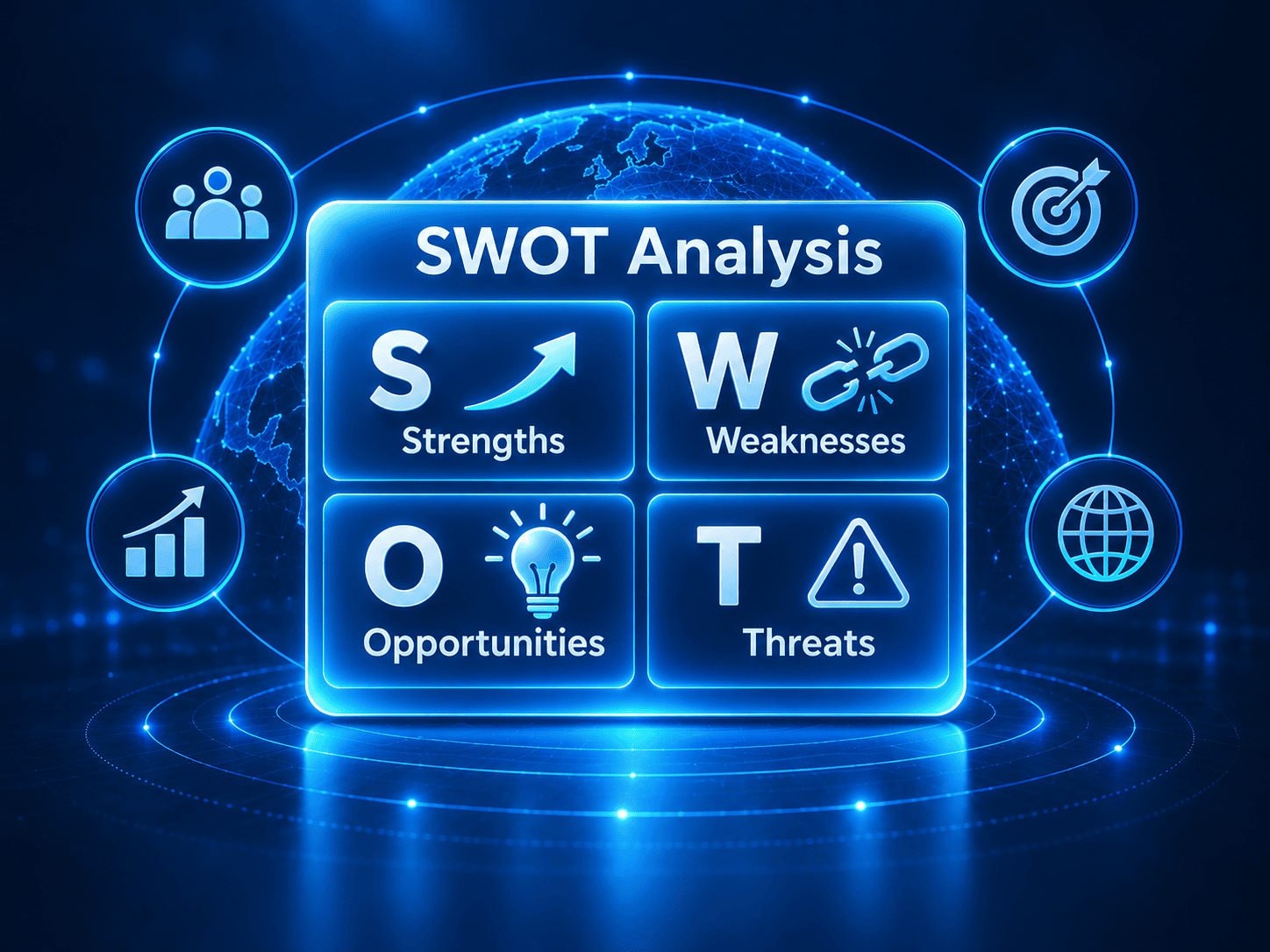
The TOWS matrix builds on SWOT analysis. It combines external opportunities and threats with internal strengths and weaknesses to develop strategic options. To produce meaningful results, organisations should verify their findings and prioritise the most relevant factors. They should also avoid vague or unstructured lists.
SWOT should therefore form part of structured strategic decision-making. Therefore, it is neither a completed strategy nor an end in itself.
What is SWOT analysis and why is it useful?
A SWOT analysis provides a structured overview of an organisation’s internal strengths and weaknesses. It also brings external opportunities and threats into view. As a result, examining these factors together helps businesses understand their position and assess available capabilities. It also reveals challenges that may influence future decisions.
Whether planning a product launch, entering a new market, forming a partnership or reorganising operations, this method offers different perspectives. As a result, organisations can assess their options more fully. In practice, the findings can support business planning and highlight opportunities for growth. They also help teams prioritise actions that align with organisational objectives.
A completed matrix is not yet a strategy.
Ask which factors matter, how they interact, what evidence supports them and what the organisation should do next. An attractive list of observations without priorities or decisions is not enough.
One of the main advantages of SWOT analysis is its accessibility. Its four-part structure encourages collaboration across strategy, operations, finance, technology and other business functions. As a result, teams can bring different perspectives into a shared strategic overview. However, this straightforward framework does not automatically guarantee reliable or actionable results.
Without a clear purpose and systematic evaluation, SWOT exercises can produce lengthy lists of vaguely defined factors. Some lists exceed 40 observations. If teams do not verify, prioritise or connect these findings to strategic decisions, SWOT can become a one-off exercise. Consequently, its practical value remains limited. Effective SWOT analysis therefore requires more than simply identifying strengths, weaknesses, opportunities and threats.
To support meaningful strategic planning, organisations should establish clear objectives and use credible evidence. They should also involve relevant stakeholders and identify the factors with the greatest influence on their goals. The focus should extend beyond identifying individual factors to understanding their relationships, determining priorities and translating findings into practical actions. In addition, regular reviews help keep the analysis relevant as internal capabilities and external conditions change.
When is SWOT analysis useful for your organisation?
SWOT analysis can be applied across industries and organisations of all sizes. It is particularly useful when evaluating an organisation’s current position, identifying strategic priorities or deciding on a future direction. For example, teams use SWOT for business planning, market entry, product and service development, organisational change and strategy reviews. It can also inform the evaluation of new opportunities.
Depending on the objective, the analysis may cover an entire organisation or focus on a specific business challenge. For this reason, teams can revisit SWOT during quarterly, half-yearly or annual planning. As a result, they can reassess priorities and respond to changing conditions. For additional practical guidance, the SWOT analysis guide provides a useful reference. The following questions can help determine when a structured assessment would add value.
Do you need a shared view of your organisation’s competitive position? Or are you assessing a proposed investment, a new market or a specific project? A focused question produces more useful findings than an undefined company-wide brainstorming session.
Can the team explain, with evidence, what genuinely differentiates the organisation from its competitors? Which internal capabilities and resources contribute to the objective?
Which processes, skills, technologies, resources or unclear responsibilities make the objective harder to achieve? Can you distinguish an observed symptom, such as missed deadlines, from its underlying cause?
Which technological, commercial, regulatory, customer or supply-chain changes could create opportunities or threats? Are different departments identifying different signals from the same environment?
Can colleagues identify the factors that require the earliest action? Invite diverse perspectives, then check, consolidate and rank the findings rather than automatically accepting every suggestion made in a workshop.
The key elements of SWOT analysis
Understanding the four SWOT quadrants
Two dimensions guide classification. Strengths and weaknesses concern factors internal to the organisation, while opportunities and threats primarily concern developments outside its direct control. Therefore, each factor should be specific, relevant to the objective and supported by suitable evidence.
However, the four quadrants are only a starting point. For this reason, related methods can make the findings more useful. TOWS helps develop strategic options, while PESTLE examines external influences. Formal risk assessment provides a more systematic evaluation of significant threats or weaknesses.
Strengths
Strengths are internal assets, resources and capabilities that help the organisation achieve its goal or give it a competitive advantage. For example, strengths may include specialist expertise, a capable team, customer relationships, strong reputation or efficient processes. Proprietary technology, sound data, financial stability and distinctive competences may also count. A useful statement therefore explains which expertise exists, why it matters and how it supports the defined objective. “A good team” alone is too vague; Business Queensland recommends concrete supporting information.
Weaknesses
Weaknesses are internal factors that reduce the organisation’s ability to achieve its objectives. Examples include inefficient processes, skills shortages, outdated technology and poor data. In addition, high costs, reliance on particular individuals and unclear responsibilities may create constraints. The purpose, however, is improvement rather than assigning blame. Distinguish symptoms from causes. For example, persistent project delays may be symptoms of poor role definition, insufficient resources or an ineffective workflow.
Opportunities
Opportunities are external developments that an organisation could exploit. Examples include new market segments, advancing technology, changing customer behaviour, potential partnerships and regulatory changes. An experienced software development team is an internal strength. By contrast, growing demand for a service that team could build is an external opportunity. Therefore, use environmental evidence, including PESTLE analysis, to identify opportunities rather than relying only on assumptions.
Threats
Threats are external factors that could negatively affect the organisation or its aims. Examples include new competitors, shifting customer needs, regulatory changes, supply disruption, labour shortages, technological shifts and economic uncertainty. Such conditions are generally beyond direct organisational control and may call for a response plan. However, identifying a SWOT threat does not complete a risk assessment. The matrix does not systematically determine likelihood, impact, risk level or controls.
SWOT and TOWS
SWOT categorises internal and external conditions. Weihrich’s TOWS matrix takes the next step. It links strengths with opportunities (SO), strengths with threats (ST), weaknesses with opportunities (WO), and weaknesses with threats (WT). In turn, these combinations suggest ways to use capabilities, protect against adverse change, remove constraints and address vulnerable situations. The objective, therefore, is to develop strategic alternatives rather than merely catalogue facts.
SWOT and PESTLE
PESTLE examines political, economic, social, technological, legal and environmental influences. It can supply structured evidence for the opportunity and threat quadrants of SWOT. In turn, SWOT adds the internal capabilities and weaknesses needed to judge what external developments mean for the organisation. Blue Octopus supports both methods within its business analysis functionality.
SWOT and formal risk assessment
SWOT can identify threats and weaknesses that warrant investigation, but it is not a substitute for formal risk assessment. Where needed, risk analysis assesses the likelihood and consequences of a defined risk. Next, it determines the risk’s significance and considers appropriate treatments or controls. A serious SWOT finding may therefore feed into a separate, structured risk management process. Teams should not treat it as an assessed risk automatically.
How to conduct an effective SWOT analysis
An evidence-based SWOT analysis follows ten practical steps. These take teams from a clearly defined question to strategic action and periodic review.
Define the purpose clearly
Specify exactly what you are analysing. A whole-organisation SWOT will differ from one for a product launch, entry into a foreign market or a particular project. As a result, an overly broad question often produces generic findings.
Gather relevant information
Do not rely on spontaneous brainstorming alone. For example, consider business results, process performance, customer feedback, workforce information and market research. In addition, review competitors and other relevant internal and external evidence. Hill and Westbrook identified the lack of verification as a major weakness in practical SWOT work.
Involve different perspectives
Include people who understand different parts of the organisation. As a result, different views reduce the chance that the matrix reflects only a manager’s or one department’s assumptions. Australian Government guidance likewise recommends gathering contributors with varied perspectives.
Separate internal and external factors
Ask whether the organisation can directly manage or substantially influence each factor. If so, it will usually fall under strengths or weaknesses. If a factor comes mainly from the operating environment, it is more likely an opportunity or threat. Examples include competitors, suppliers, political developments and financial markets.
Write precise statements
Avoid isolated labels such as “competition”, “technology”, “good team” or “growing market”. Explain what the issue is, why it matters for the objective and, where possible, the evidence supporting it. As a result, specific findings can be assessed and acted upon; vague statements cannot.
Verify important findings
Support material claims with data wherever possible. If customer satisfaction is considered a strength, check survey results or retention data. If market growth is labelled an opportunity, verify current market evidence. In turn, this helps prevent strategies being built on incorrect assumptions.
Set priorities
However, not every factor deserves equal attention. Business Queensland suggests selecting approximately three to five issues per quadrant and then prioritising them. Kurttila and colleagues combined SWOT with the Analytic Hierarchy Process (AHP) to weight factors systematically. In practice, most organisations do not need AHP. Even so, they need a defensible way to identify what matters most.
Connect the factors
Use TOWS to explore four strategic combinations. Strengths + opportunities: use what you do well to capture opportunities. Strengths + threats: apply capabilities to reduce exposure. Weaknesses + opportunities: address internal gaps that block potential gains. Weaknesses + threats: identify especially vulnerable combinations that require attention.
Turn conclusions into actions
Give each important finding a meaningful next step: a strategic decision, project, improvement measure, further investigation or formal risk assessment. Then define a responsible owner, required resources or budget, and a target date. Business Queensland specifically recommends an action plan with responsibilities and review times.
Review SWOT regularly
SWOT captures conditions at a particular point in time. Therefore, review it when important internal or external conditions change and during routine strategy cycles. Dyson’s Warwick study and the work of Pickton and Wright support an iterative approach to SWOT. Rather than a static exercise, SWOT should sit within the wider planning process.
The outcome is not just a completed four-quadrant matrix. To turn SWOT into a practical management tool, prioritise factors and link strategic options. Keep supporting evidence, accountable actions and an agreed review cycle. Where material threats warrant further analysis, use a separate formal risk assessment.
How Blue Octopus supports SWOT analysis
Blue Octopus helps organisations structure SWOT analysis and connect its findings to decision-making and follow-up. For example, its business analysis modules describe structured SWOT and links from PESTLE. In addition, they explain how critical weaknesses and threats can move into risk analysis. As a result, teams can follow a more consistent process than they could with isolated documents.
Blue Octopus does not validate the quality of the evidence or make strategic decisions on the organisation’s behalf. If the inputs are incomplete or the findings are not checked, a well-structured matrix will not produce a sound strategy.
The main benefit is continuity: significant SWOT findings can be related to other analyses, risks, responsibilities, supporting information and actions. This reflects the wider academic view of SWOT. In practice, the method works best when integrated with other strategic approaches rather than treated as a standalone exercise.
Frequently asked questions about SWOT analysis
Practical answers about SWOT, TOWS, PESTLE, priorities, risks and strategic use.
SWOT stands for Strengths, Weaknesses, Opportunities and Threats. The framework reviews an organisation’s internal capabilities and constraints. It also considers external developments that could help or harm the organisation.
Strengths and weaknesses usually refer to the organisation’s internal characteristics, resources and operations. By contrast, opportunities and threats arise mainly from the external environment. For example, Australian Government and Business Queensland guidance uses this distinction.
SWOT organises internal and external factors into four categories. Heinz Weihrich introduced TOWS to help develop possible strategies. Specifically, the method links opportunities and threats with internal strengths and weaknesses.
No. The traditional framework provides no built-in objective ranking of the factors. Therefore, additional judgement and prioritisation are needed. Kurttila and colleagues developed a SWOT–AHP approach partly to address this limitation.
No. SWOT can reveal threats, weaknesses and other issues. However, formal risk assessment also examines likelihood, consequences, risk levels and appropriate measures or controls.
SWOT combines internal strengths and weaknesses with external opportunities and threats. PESTLE focuses on the wider political, economic, social, technological, legal and environmental landscape. PESTLE findings can therefore inform the opportunities and threats in SWOT.
There is no universal rule, but long lists can reduce usefulness. Business Queensland recommends selecting approximately three to five key issues from each quadrant. Next, teams should prioritise those issues before preparing an action plan.
There is no universally prescribed interval. Therefore, review SWOT whenever major internal or external conditions change. Also include it in regular strategic planning cycles, such as quarterly, half-yearly or annual reviews, where appropriate.
It is not well supported to attribute SWOT confidently to one individual. Instead, its roots lie in business policy and strategy work at US business schools during the 1960s. Kenneth Andrews’s work on matching external circumstances with internal capabilities was part of that development. However, the claim that Albert Humphrey definitively invented SWOT remains contested and should not be presented as fact.
Official sources
Next steps after SWOT analysis
A useful SWOT analysis does not end when the four quadrants have been filled in. Start with a clear decision or objective, then gather reliable internal and external evidence. Involve different perspectives, and distinguish internal factors from changes in the operating environment.
Next, verify and prioritise the most significant findings. Use a TOWS-style discussion to connect them and turn the strongest options into decisions, actions, owners and review dates. In addition, commission a separate structured risk assessment where a critical threat warrants it.
Blue Octopus can help structure SWOT and PESTLE findings and connect critical issues to risk analysis. It also supports assigned responsibilities and coordinated follow-up work. The value of the method, however, still depends on evidence and sound strategic judgement.