


Risk Analysis
Identify, Assess and Prioritise Business Risks
Risk analysis examines what could affect an organisation’s objectives, how likely significant events are and what their consequences could be. As a result, it helps teams turn uncertainty into documented, comparable judgements rather than treating every concern as equally urgent.
A useful analysis considers the organisation’s context, affected assets and processes, evidence, existing safeguards and the decisions that follow. For example, it can cover operational disruption, cyber incidents, suppliers, projects, finance, safety or strategic change. Above all, the method should suit the decision and the level of uncertainty involved.
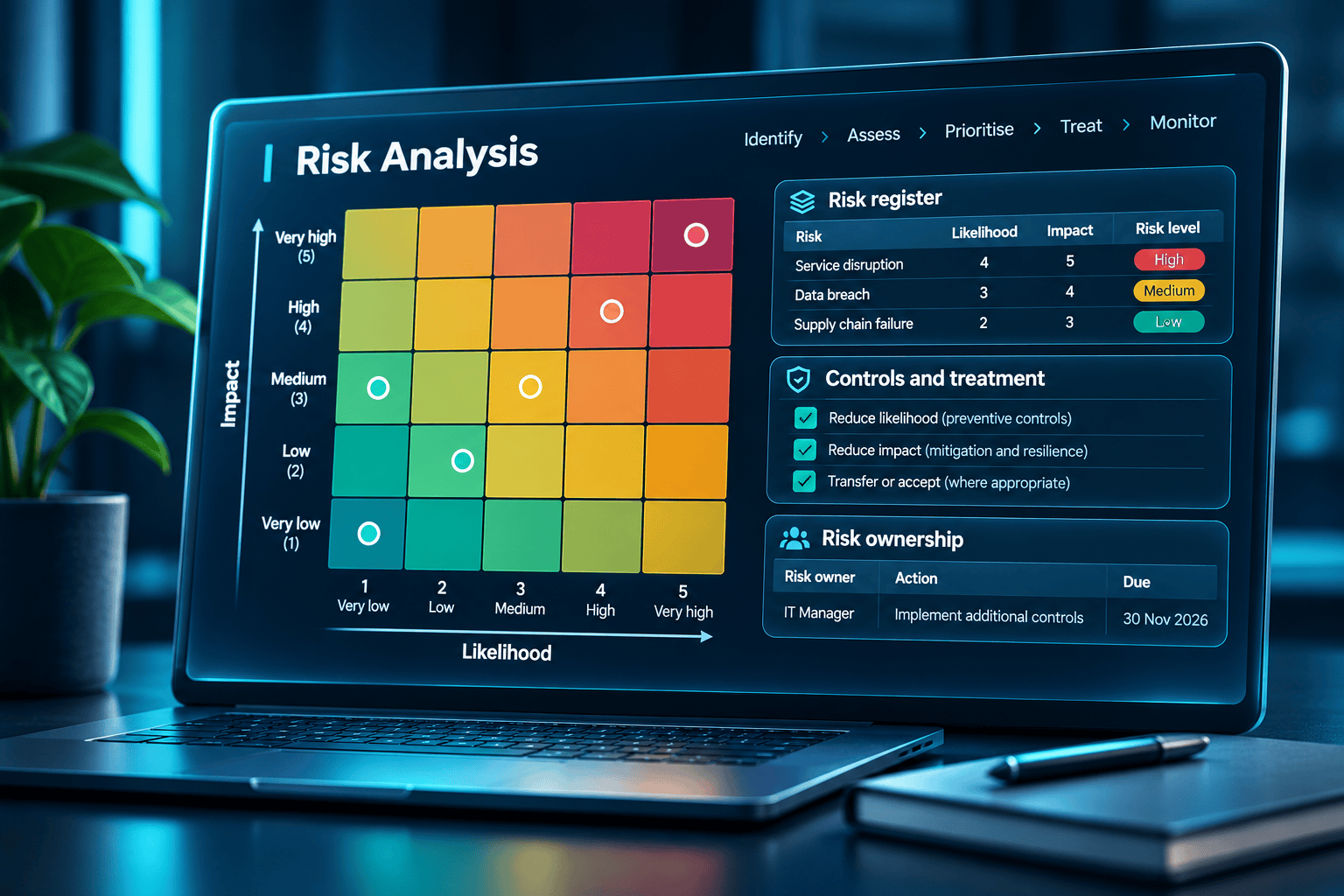
Risk identification, analysis and evaluation are related but distinct activities. First, identification describes what might happen. Next, analysis explores likelihood, consequences and controls. Finally, evaluation compares the findings with agreed criteria to decide which risks require action.
ISO 31000:2018 remains the published international guidance for risk management; a revised edition is still under development. However, risk analysis is not a one-off scoring exercise. For this reason, reassess risks when material assumptions, controls or business conditions change.
What is risk analysis and why does it matter?
Risk analysis investigates the nature and level of an identified risk. In particular, it examines how an event might unfold and why it could occur. It also considers the objectives or services affected and the likely effectiveness of current controls. In turn, a useful risk statement connects a plausible event or cause with a meaningful consequence.
For example, a team should describe more than “supplier failure”. It might record: “If our sole logistics provider cannot operate for five working days, customer orders may be delayed, creating contractual penalties and reputational damage.” As a result, assessors can examine dependencies, alternatives, potential impact and evidence more clearly.
The wider ISO 31000 framework places analysis alongside establishing context, identification, evaluation, treatment, communication and monitoring. Ultimately, the purpose is better decisions—not producing a colourful matrix in isolation.
A risk score is an aid to judgement, not a prediction.
Different causes can produce the same score but require very different responses. Therefore, keep assumptions, affected objectives, existing controls and the assessment rationale visible alongside the rating.
Simple qualitative scales can help teams compare risks consistently. However, numerical precision should not be overstated. A 5 × 5 likelihood-impact matrix is an illustrative prioritisation tool, not a universal ISO requirement or a probability model. Even so, rare events with catastrophic consequences may deserve attention despite a moderate calculated score.
Risk analysis works best when specialists supply evidence, business owners explain consequences and decision-makers agree what levels of exposure are acceptable. Therefore, document uncertainty and revisit scores when better information becomes available.
When should an organisation use risk analysis?
Organisations use risk analysis before significant decisions and to understand exposure in existing activities. For example, triggers include adopting a cloud platform, opening a new facility, relying on one supplier, introducing automation, changing a business process or responding to a new threat. In addition, risk analysis helps identify which controls and continuity arrangements deserve investment.
Different teams need different depths of analysis. For example, a small project may justify a workshop and qualitative matrix. By contrast, a safety-critical or high-value decision may require scenarios, quantitative estimates, specialist engineering methods or independent review. IEC 31010:2019 provides guidance on selecting risk assessment techniques for different situations.
There is no universal legal duty to use one risk matrix. However, specific organisations may be subject to sector obligations. For example, Article 21 of the NIS2 Directive addresses cybersecurity risk-management measures for entities within scope, including policies on risk analysis and information-system security. Applicable national law and sector rules determine the organisation’s actual obligations.
The seven elements of a reliable risk analysis
What should an assessment contain?
Reliable assessments use a consistent set of questions, but the level of detail should reflect the situation. First, record the objective, context and risk event. Then examine the likely consequences and existing controls. Finally, estimate remaining exposure and compare it with agreed criteria.
Moreover, a risk register should preserve more than a single red, amber or green rating. It should also show the owner, supporting evidence, current and target position, response, actions, review date and material uncertainty. The seven elements below provide a practical structure for business and cybersecurity risk analysis.
Context and objectives
Begin with the outcome that must be protected or achieved. Specify the activities, assets, processes, geographical areas and planning horizon included in the assessment, together with internal policies and relevant stakeholders.
For example, a five-day supplier interruption may be tolerable for one business function and disastrous for another. Therefore, assess the event against the actual service, customer commitments, dependencies and objectives involved. PESTLE analysis can help identify external conditions influencing the assumptions.
Events, causes and vulnerabilities
Describe each risk as a plausible event or change and explain its causes and consequences. For example, sources may include previous incidents, supplier intelligence, audits, employee experience, threat assessments and SWOT findings.
Do not mistake a broad category such as “cybersecurity” for an actionable risk. Instead, describe a specific scenario such as “unauthorised access to customer records following a compromised administrator account”. This allows you to discuss controls, likelihood and business impact. Where relevant, also record opportunities separately when they affect objectives.
Likelihood and evidence
Here, likelihood expresses the chance that a scenario may occur over a stated period. For example, a five-level qualitative scale might range from rare to almost certain. Where reliable data exist, quantitative assessment may use frequencies or probability distributions. Before using a scale, explain what each level means.
Evidence can include incident history, exposure, vulnerability, supplier concentration, environment and control performance. However, where data are limited, record the judgement as uncertain rather than implying an exact probability. Specialist input may also be necessary for complex or low-frequency hazards.
Consequences and dependencies
Evaluate what would happen if the scenario occurred. For example, consider financial losses, service availability, customers, legal duties, safety, reputation, confidential information and recovery effort. Therefore, impact scales should reflect the organisation’s size and tolerance, not an arbitrary generic figure.
For example, a one-day outage could be manageable for an internal reporting tool but unacceptable for a customer-facing payment service. Consequently, connecting the risk with process and asset dependencies gives a clearer account of potential impact and recovery needs.
Existing safeguards and effectiveness
List the controls already operating. These include prevention measures that reduce likelihood, detection measures that identify problems and resilience arrangements that limit consequences. Then assess their effectiveness using available tests, evidence and ownership information.
A documented backup policy does not equal a verified recovery capability. In addition, control weaknesses may invalidate an optimistic risk estimate. Preserve the distinction between initial exposure, exposure under existing controls and the expected position after proposed measures.
Initial and residual risk
Inherent (initial) risk describes exposure before the effect of selected controls is taken into account; residual risk describes what remains after existing or planned controls, depending on the organisation’s methodology. Therefore, state clearly which definition and assessment point your register uses.
As a simple worked example, a service outage might receive illustrative likelihood 4 and impact 5, giving 20 on a 5 × 5 matrix. After tested redundancy and recovery arrangements, a reassessment might assign 2 and 4, giving 8. However, these numbers are illustrative ratings, not measured probabilities. They depend on evidence that the controls operate as assumed.
Evaluation, ownership and response
Compare analysed exposure with the organisation’s risk appetite, tolerance and escalation rules. Then record who can accept each level, which risks require action and whether further investigation is needed. However, a moderate score may still require escalation when safety, contractual or legal exposure is significant.
A useful register entry might read: R-014 — logistics provider outage; owner: Operations Director; initial rating: High; treatment: qualify a second carrier and test manual order handling; review: after the continuity exercise. Risk responses may reduce, avoid, share or deliberately retain exposure where justified; risk ownership and review remain essential.
How to conduct a risk analysis: nine practical steps
The following nine-step approach adapts established risk-management principles to an operational assessment. Choose the depth of analysis and techniques to match the decision and uncertainty involved.
Define the decision and assessment horizon
Name the decision, service or objective being assessed. Agree the time period, boundaries, team, expected output, decision owner and risk criteria before discussing scores.
Map important assets and dependencies
Identify critical processes, information, systems, suppliers and affected stakeholders. Also include material single points of failure and assumptions about substitute resources.
Write clear and testable risk statements
Use workshops, incident records, audits, SWOT or PESTLE findings and expert input to define plausible events, causes and consequences. Avoid vague labels without a scenario.
Agree likelihood and impact scales
Specify measurable or consistently described rating levels, escalation thresholds and acceptance authority. Then decide whether qualitative, semi-quantitative or specialist quantitative methods fit the decision.
Estimate likelihood and business consequences
For each scenario, consider the evidence, relevant period, sources of uncertainty and effects across people, customers, processes, finance and information. Also keep the rationale with the score.
Review current safeguards and exposure
Assess existing prevention, detection and recovery controls using tests or other evidence. Then document initial risk and the residual exposure under the controls counted in the methodology.
Prioritise against agreed risk criteria
Compare each risk with appetite, tolerance, criticality and regulatory duties. However, escalate severe or poorly understood scenarios even when a simple matrix does not put them at the top.
Select responses and accountable owners
Choose proportionate responses. For example, you might avoid an activity, reduce exposure, share consequences or accept residual risk through an authorised decision. Name owners, actions, resources and deadlines.
Monitor changes and check effectiveness
Track treatment progress, control results, incidents and emerging conditions. Finally, reassess after significant changes and communicate remaining risk to the authorised decision-makers.
A complete assessment should produce a traceable risk register, agreed decisions and a treatment plan—not only a workshop summary. For cyber risks, NIST SP 800-30 provides more detailed assessment guidance; IEC 31010 outlines techniques for different contexts. Review owners, deadlines and control evidence as circumstances evolve.
How Blue Octopus supports risk analysis
Blue Octopus supports the organisational work around identifying, assessing, documenting and following up business risks. Its published modules overview describes risk visualisation, adjustable level thresholds, separate initial and residual assessments, mitigation measures, links with processes and individual assets, and data export. It also documents transferring significant SWOT weaknesses and threats into risk analysis.
For example, a team reviewing a high-impact software dependency can record the affected asset, evaluate the likelihood and consequences of an outage, describe mitigation measures and revisit residual exposure after controls are implemented. The resulting assessment can be connected with the relevant business process rather than held in an isolated spreadsheet.
These features support structured management. However, they do not scan for vulnerabilities, guarantee that controls work or establish compliance automatically. Specialists and accountable decision-makers must still validate evidence, implement controls and review risk decisions.
Frequently asked questions
Practical answers about assessment methods, scoring, residual exposure and risk responsibilities.
Risk assessment usually includes identifying risks, analysing likelihood and consequences, and evaluating findings against criteria. Within that process, risk analysis is the investigative part. Treatment then follows when a response is needed. Because the terms are sometimes used loosely, organisations should define them in their methodology.
One common illustrative approach multiplies an ordinal likelihood rating by an impact rating, such as 4 × 5 = 20. However, the result is a relative prioritisation score, not a measured probability or expected monetary loss. Therefore, document scales, thresholds and exceptions. Review high-consequence rare events explicitly.
Inherent or initial risk describes exposure before accounting for a defined set of safeguards. By contrast, residual risk is the exposure remaining after controls are taken into account. The precise boundary depends on the organisation’s method; always state whether the residual estimate reflects operating controls or proposed treatments.
Choose a technique according to the decision, data availability, consequences, uncertainty and available expertise. A qualitative register may suit everyday operational risks, whereas complex safety, engineering or financial questions may need scenario analysis, fault trees or quantitative modelling. IEC 31010 provides a framework for selecting techniques.
Requirements, reviews and tools
No. NIS2 obligations concern entities within the directive’s scope and apply through the relevant legal framework. Article 21 includes policies on risk analysis and information-system security among cybersecurity risk-management measures. Moreover, sector-specific implementing rules may add detail. Therefore, check national transposition and your organisation’s actual classification.
There is no universal review schedule for all risks. Set a frequency based on criticality, change and applicable requirements. Then reassess after major incidents, new suppliers, system changes, ineffective controls or emerging threats. In addition, keep ownership, decisions, evidence and outstanding actions up to date.
No. Blue Octopus offers structures for evaluation, visualisation, mitigation records and links to assets and processes. Nevertheless, the quality of the result depends on evidence, competent judgement, accountable risk owners and effective real-world controls. In particular, software does not confer certification or regulatory compliance.
Standards and authoritative sources
Next step
Effective risk analysis begins with a clearly defined decision and ends with an accountable response. First, map the relevant processes and assets, then describe credible scenarios and document assumptions. Next, evaluate existing controls and compare the results with agreed acceptance criteria. Treat the register as a living management record, not an annual exercise.
Blue Octopus can help organise the assessment, visualise exposure and connect risks with processes, assets and follow-up actions. Explore the platform modules to understand the available risk-management capabilities and decide how they fit your organisation’s method.