


Business continuity planning starts with a simple question: what happens when a critical business application becomes unavailable? Without clear recovery priorities, even a short disruption can affect essential services, employees and customers.
Asset management software for business continuity helps organisations identify critical information assets, understand their dependencies and prepare for potential disruptions. By connecting asset records with Business Impact Analysis (BIA), Recovery Time Objectives (RTO) and Recovery Point Objectives (RPO), teams can make more informed recovery decisions.
Platforms such as Blue Octopus support this process through structured asset management, risk assessment and business continuity planning.
Why Business Continuity Planning Matters
Business continuity planning helps organisations prepare for incidents that could interrupt important operations. These disruptions may involve system failures, cyber incidents, supplier outages or unavailable business applications.
An effective plan identifies critical activities, responsible teams and suitable recovery arrangements. However, organisations must first understand which information assets support their essential processes. Accurate asset records provide a foundation for these decisions.
How Business Impact Analysis Identifies Critical Assets
Business Impact Analysis (BIA) examines how disruptions could affect business activities over time. It helps organisations identify essential processes, evaluate potential operational and financial consequences, and establish recovery priorities.
For example, a company may depend on a cloud application for customer orders. If that application becomes unavailable, several departments could experience delays. By connecting the application with related information assets and business processes, management can better understand the potential impact.
As a result, BIA supports continuity planning based on business needs rather than technical assumptions alone.
Understanding RTO and RPO in Recovery Planning
Two important recovery objectives help organisations define their expectations after a disruption.
Recovery Time Objective (RTO)
RTO defines the target time within which a service or process should be restored after a disruption. For example, an RTO of four hours means the organisation aims to restore the affected service within that period. Setting realistic recovery objectives helps teams plan appropriate resources and procedures.
Recovery Point Objective (RPO)
RPO defines the maximum targeted period of data loss, expressed in time. For example, an RPO of one hour means recovery arrangements should aim to limit data loss to no more than one hour of changes. Unlike RTO, which concerns restoration time, RPO focuses on how much recent data an organisation can afford to lose. Together, these objectives help teams plan suitable backup, recovery and continuity arrangements.
How Centralised Asset Records Support Recovery
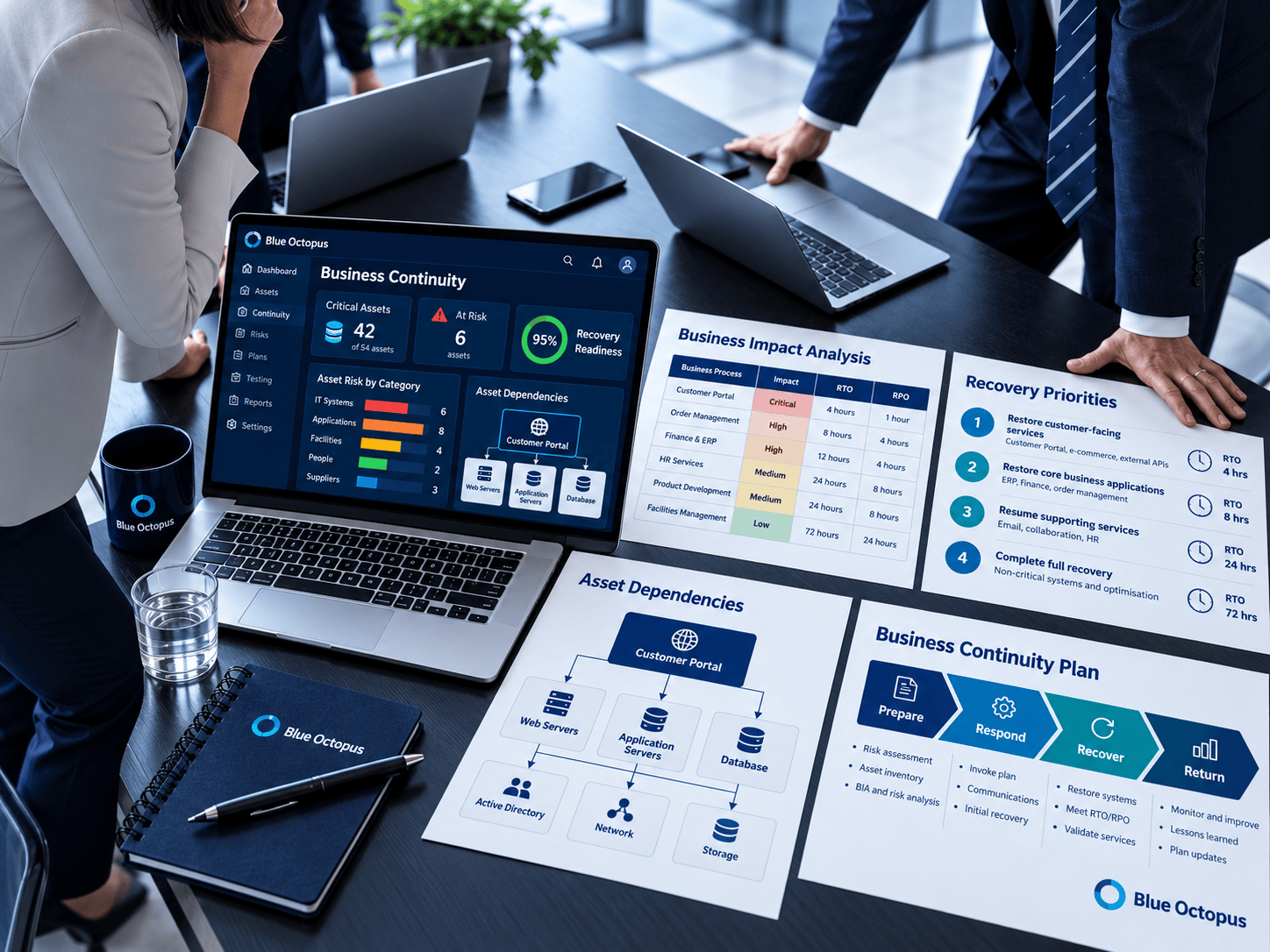
Recovery planning becomes more effective when organisations understand the relationships between assets and business processes. A structured information asset register helps teams identify critical applications, responsible owners and supporting infrastructure.
For example, several services may depend on the same database. Documenting this dependency allows management to evaluate which activities could be affected if the database fails. Furthermore, connecting asset information with BIA results helps teams establish suitable recovery priorities.
| Element | Purpose |
|---|---|
| BIA | Identifies critical activities and assesses disruption impacts |
| RTO | Defines the target time for restoring a service |
| RPO | Defines the maximum targeted period of data loss |
| Asset dependencies | Show which systems and processes rely on one another |
These records support recovery planning. However, asset management software does not automatically restore systems or replace technical backup solutions.
Business Continuity and Compliance Requirements
Business continuity is also relevant to information security management and regulatory preparation. ISO/IEC 27001 provides a risk-based framework for information security management, including controls addressing information security during disruptions and ICT readiness for business continuity.
The EU NIS2 Directive also includes business continuity, backup management and disaster recovery among its cybersecurity risk management requirements. In Slovenia, Article 21 of ZInfV-1 requires covered essential and important entities to maintain documented business continuity arrangements, including Business Impact Analysis and recovery planning.
These obligations do not automatically apply to every organisation. Businesses should assess the requirements relevant to their activities and legal status.
How Blue Octopus Supports Business Continuity
Blue Octopus connects information asset management with business processes, risk assessments and continuity planning. The platform supports information asset registers, criticality classification and visual dependency mapping.
Its Business Impact Analysis module also helps organisations assess the consequences of potential disruptions and define RTO and RPO values for relevant processes, services and assets. Teams can document alternative procedures and connect continuity information with broader risk management activities.
For example, management can identify a critical business process, review its dependencies and establish recovery priorities based on potential operational impacts. Blue Octopus supports planning and documentation, but it does not replace backup systems, disaster recovery technologies or real-time infrastructure monitoring.
Explore the Blue Octopus modules for more information.
Frequently Asked Questions
BIA helps organisations understand how disruptions affect important activities and establish suitable continuity and recovery priorities.
RTO defines the target time for restoring a service. RPO defines the maximum targeted period of data loss.
Not directly. It supports asset visibility, risk assessment and recovery planning, but preventing and resolving technical failures requires additional operational and security measures.
Yes. It can help organise continuity plans, responsibilities and supporting documentation. However, software alone does not guarantee regulatory compliance.
Build Stronger Business Continuity Planning
Effective business continuity requires reliable asset information, clear recovery objectives and defined responsibilities. By connecting BIA, RTO, RPO and information asset dependencies, organisations can prepare more effectively for operational disruptions.
Discover Blue Octopus to explore how structured asset management and continuity planning can support your business.