


Asset dependency mapping helps organisations understand how business applications, databases and cloud services connect. These resources rarely operate independently. One system may support several business processes, while multiple applications may rely on the same external provider. Without a clear understanding of these relationships, organisations can struggle to assess risks and prepare for disruptions.
Asset dependency mapping helps teams identify how information assets connect and which resources support essential operations. Visualising these relationships makes complex systems easier to understand and supports more informed risk management decisions. Platforms such as Blue Octopus help organisations document information assets, visualise dependencies and connect them with structured risk assessments.
What Is Asset Dependency Mapping?
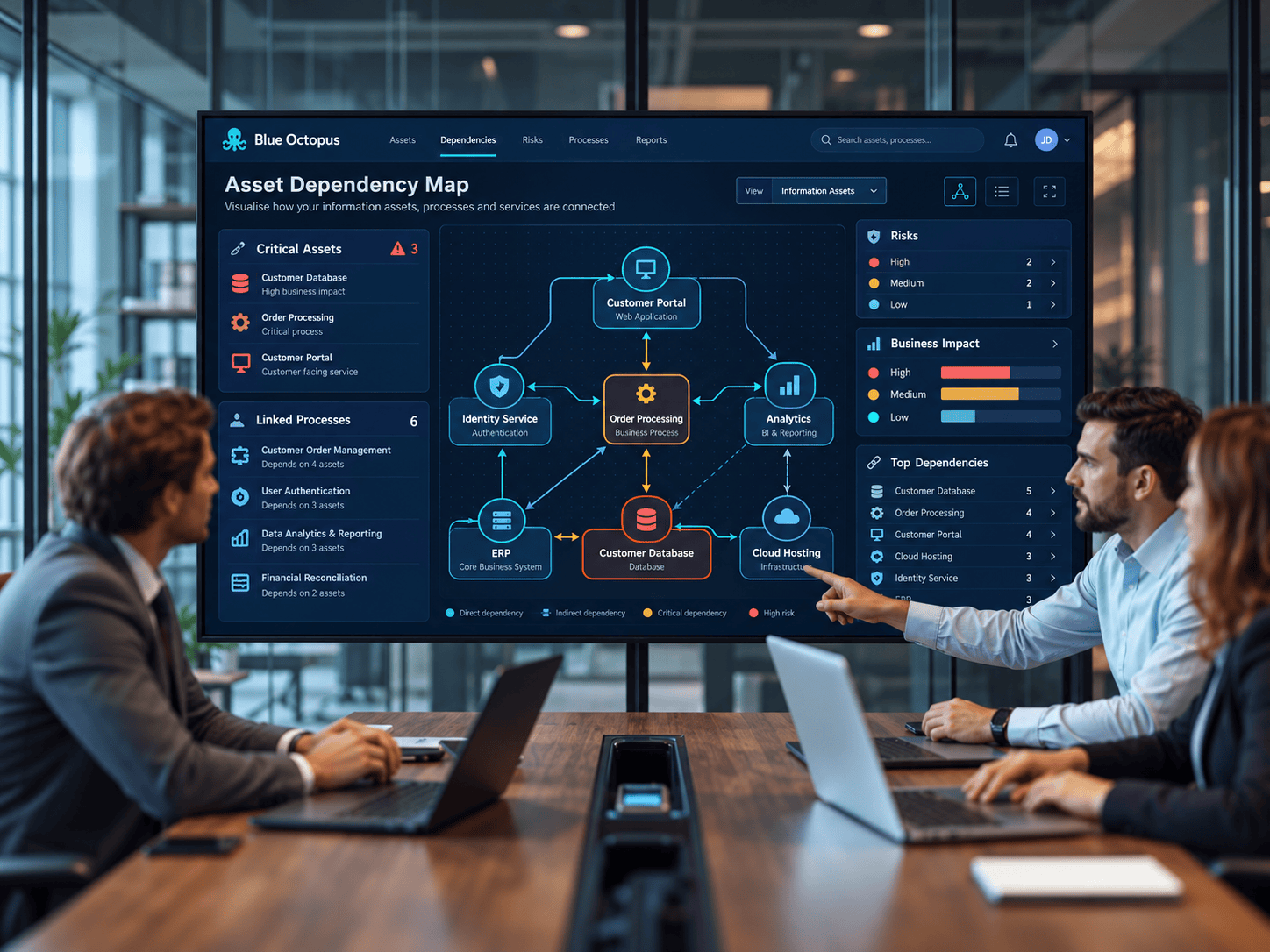
Asset dependency mapping identifies relationships between information assets, including applications, databases, infrastructure components and external services. For example, an online ordering application may depend on a customer database and a cloud hosting provider. If the database becomes unavailable, the ordering process could stop even though the application itself remains operational.
By documenting these connections, organisations can understand which resources depend on one another and identify potential operational weaknesses. A dependency map also provides useful context when teams review changes, assess risks or plan recovery activities.
Why Visualising Asset Relationships Matters
Traditional asset inventories describe individual resources. However, they may not clearly show how those resources interact. A visual dependency graph provides a different perspective. Instead of reviewing separate records, teams can examine connections between important systems.
This approach offers several practical benefits:
- Identifies shared resources that support multiple services.
- Makes complex system relationships easier to understand.
- Supports communication between technical teams and management.
- Helps teams evaluate the possible impact of changes or disruptions.
For instance, a shared authentication service may support several business applications. Understanding that relationship allows management to recognise its broader importance. However, visualisation is only useful when the underlying asset information is accurate and regularly reviewed.
Practical Applications of Asset Dependency Mapping
Using Dependency Mapping for Risk Assessment
Understanding dependencies helps organisations evaluate risks in their business context. Consider a critical application that relies on an external cloud provider. The organisation may have appropriate controls for the application itself but limited visibility into risks associated with the provider.
By examining the dependency, teams can identify possible consequences of a supplier outage and assess the likelihood and impact of disruption. They can then review existing safeguards, assign responsible owners and determine whether additional mitigation measures are necessary.
Furthermore, dependency mapping supports the identification of potential single points of failure. These are resources whose unavailability could affect several important services. The map does not automatically identify every security weakness. Instead, it provides information that helps teams assess operational risks more effectively.
Supporting Business Impact Analysis and Recovery Planning
Business Impact Analysis (BIA) helps organisations determine how disruptions could affect critical business activities. Asset dependency mapping provides useful information for this process because it reveals which resources support those activities.
For example, a company may discover that several essential services rely on one database. As a result, the database’s availability becomes an important consideration in recovery planning. By combining dependency information with BIA, management can establish more informed recovery priorities and define suitable continuity arrangements.
However, a dependency graph is not a replacement for BIA. Organisations must still evaluate business impacts, recovery requirements and available alternatives.
Managing System Changes and External Dependencies
Dependencies also matter when organisations introduce new technology or modify existing systems. Before replacing a cloud service, for example, teams should understand which applications and business processes rely on it. A documented dependency map can help identify affected resources and support better change planning.
Similarly, organisations can review relationships with external providers to understand where supplier failures might affect important operations. Regularly updating asset connections is therefore essential, particularly after significant infrastructure, application or supplier changes.
Asset Dependencies and Information Security Requirements
Asset management forms part of several information security frameworks. ISO/IEC 27001 establishes requirements for an information security management system based on risk assessment and treatment.
The EU NIS2 Directive also addresses asset management, supply chain security and business continuity among its cybersecurity risk management measures. In Slovenia, Article 21 of ZInfV-1 requires covered essential and important entities to maintain relevant asset inventories, risk assessments and business continuity documentation. Visual dependency mapping can support these activities by improving understanding of important system relationships. However, neither framework universally requires a particular visual mapping tool.
How Blue Octopus Supports Asset Dependency Mapping
Blue Octopus provides a configurable information asset register with ownership, criticality classification and hierarchical relationships. Its asset connection functionality offers an interactive graphical view of information assets and their dependencies. Teams can examine relationships across the asset environment or focus on the dependencies of a particular resource.
In addition, Blue Octopus supports structured risk assessments and Business Impact Analysis. This allows organisations to connect information about critical resources with broader risk and continuity planning activities. For example, a team can identify an important application, review its dependencies and assess the operational risks associated with supporting services.
Blue Octopus focuses on structured information management. It does not automatically discover every network connection or monitor infrastructure failures in real time. Explore the Blue Octopus modules to learn more about its asset management and dependency visualisation capabilities.
Frequently Asked Questions
It is the process of identifying and documenting relationships between information assets, such as applications, databases, cloud services and supporting infrastructure.
It helps teams understand how failures or security incidents affecting one resource could influence other systems and business activities. This information supports risk assessment and prioritisation.
Yes. Understanding critical dependencies can support Business Impact Analysis, recovery planning and the identification of potential single points of failure.
Blue Octopus supports structured asset records and visual dependency relationships. However, organisations must maintain accurate asset information; the platform should not be treated as an automatic network discovery tool.
Make Better Decisions with Connected Asset Information
Understanding asset dependencies helps organisations look beyond individual systems and assess how their information environment supports business operations. By combining accurate asset records, visual relationships and structured risk assessments, teams can improve planning, identify critical dependencies and make more informed decisions.
Discover Blue Octopus to explore how visual asset dependency mapping can support your organisation.